
If your everyday life seems poor, don’t blame it; blame yourself; admit to yourself that you are not enough of a poet to call forth its riches; because for the creator there is no poverty and no poor, indifferent place.
- Rainer Maria Rilke, Letters to a Young Poet
Is your caravan lost?
It is
If you no longer weep from gratitude or happiness,
Or weep
From being cut deep with the awareness
Of the extraordinary beauty
That emanates from the most simple act
And common object.
- Hafiz
In 1903, the poet Rainer Maria Rilke struck up a correspondence with a young man who wanted to be a poet but had to work as a clerk — which I’ve always imagined as something like a junior associate — to make a living. Those letters were published in a small volume that is a pure gem.
Rilke’s Challenge: Are you Poet Enough?
Rilke challenged the clerk to be “enough of a poet” to call forth the riches in his life, even as he toiled in what some might consider the most boring of professions.
Rilke’s challenge has been an organizing principle of my life for the last 30 years or so since I read Letters to a Young Poet. As a maximizer, any challenge feels like something I should take up. And I certainly sometimes felt some kinship with the clerk , making a living at something that was not always obviously moving.
But I believe that, whatever our job, Rilke’s challenge is a fundamental human task; part of what it means to be human at all. And it can’t be outsourced. I’m the only person who can “call forth the riches” in my life. When I fail to do that, it’s on me — not my job, my clients, the people I work with, my family, or any social, economic or political system.
Goodness knows I’m no poet. By nature, I’m an analyzer, a thinker (and an overthinker).
And, to be sure, many times I failed at Rilke’s challenge, and continue to fail at it. It seems like there were years — certainly months, weeks, weekends, “worthless evenings” — where there was activity, progress, success and failure, but not much song. A numb kind of gloom.
But sometimes, on my best days, I’ve been poet enough to call forth my life’s riches. And, when I put in the effort, my legal career left plenty of fodder for “riches” to call forth. Some of the poetry I found in everyday life as a lawyer:
- The purity of hard work. Pressing your shoulder against it and feeling it yield. What more can we ask?
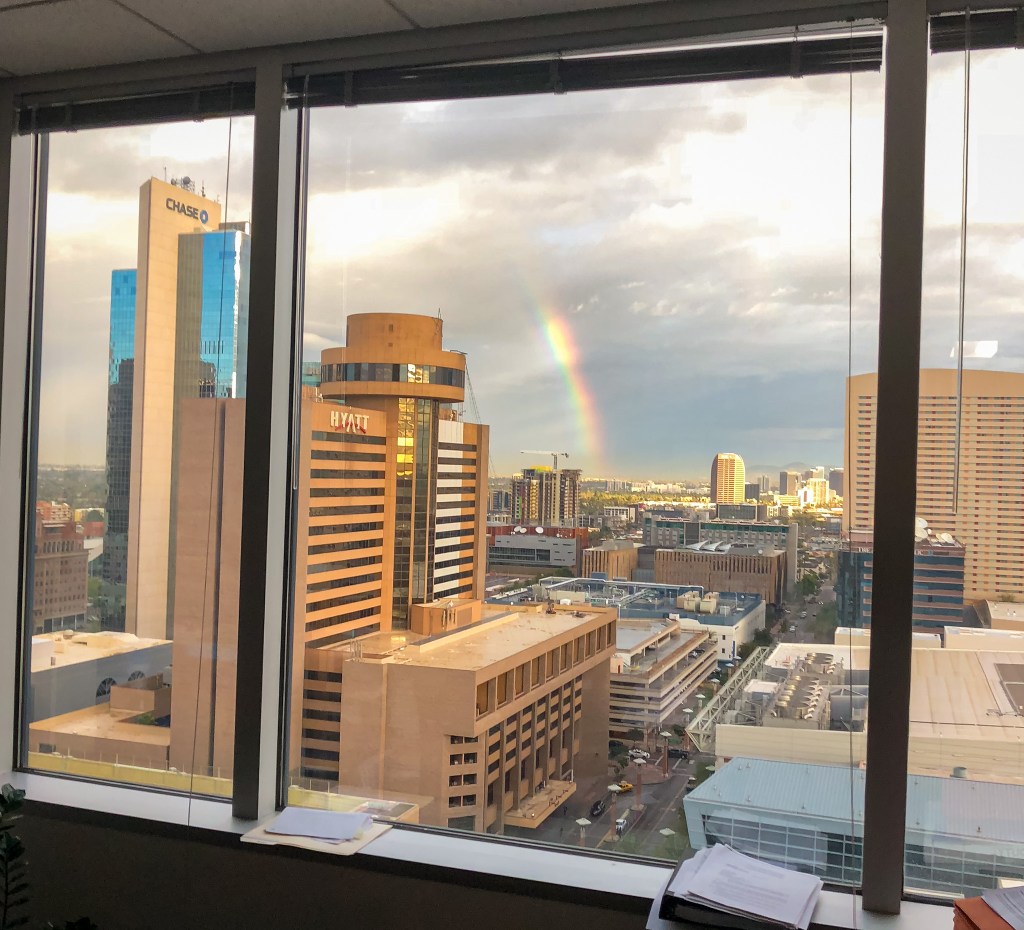
- The sun going down, or coming up, on countless conference rooms, workrooms, and offices on late nights and early mornings. We were never forsaken.
- A team, passing a laptop around a table on a tough night. Each one contributing his or her part of the motion when none of us could do it on our own. If there is something more beautiful than that, I don’t know it.
- Losing myself in fireflies with a colleague at the Broad in downtown Los Angeles after a judge’s scheduling change.
- Being “cut deep” by unexpected kindness
Becoming a better “poet”
And so what made the difference between when I could get my life to sing and when I couldn’t? Greater confidence and agency over the course of my career probably helped. And I’ll credit eating better and exercising more with just about anything. But I think a big part of it was greater acceptance of the hard spots: uncertainty, insecurity, failure.
Because poetry isn’t all sunsets and rainbows. Sometimes you are “cut deep” by (as Hafiz says) the “extraordinary beauty that emanates from the most simple act and common object.” And sometimes you are just cut deep – by harshness, disappointment, callousness, sadness, loss, perceived or actual failure.
How can we be “poet enough” when we are “cut deep” in the dark places? We do it by really feeling those dark places. By declining to use our big brains to avoid those feelings, because they are part of the “riches” of life too. Sensitive people are going to be cut deep this way plenty of times in a legal career. Some of those times I remember:
- The ritual of going to each member of the team after a disappointing defeat, to make sure they were all okay. I don’t know of a better place to put your disappointment, and will always be grateful for the colleague who introduced me to this responsibility and privilege of leadership.
- Pacing round and round and round the 16th floor late at night after a difficult revelation from a young pro bono client.
- That sinking, cringing feeling of finding a typo when the brief is already filed or accidentally sending an email to the wrong person.
- Rallying myself through self-doubt and anxiety, so many times.
- Crying in a salon chair on the day I decided I didn’t want to be a lawyer anymore. (My poor hair stylist!)
Letting myself feel those things even though they were bad helped my brain stop spinning. Doing that helped me be a more integrated human and less of a brain in a vat. By the end of my legal career, it was almost always crescendos and violins. Sometimes dark and brooding, sometimes quick and light. But never numb. Always a bit raw and alive.
And now that I’m no longer a lawyer, Rilke’s challenge still calls. Perhaps even more so. I can no longer pretend to blame my job, my clients, opposing counsel for my failure to feel – the responsibility is squarely on my shoulders, as it is for all of us.


Leave a Reply