
Doctors, columnists, and nosy friends agree: sacrifice delicious food today so your future self will thank you. But eating well doesn’t have to be framed as sacrifice. What we eat has an immediate impact on our mood, focus and ability to live well right now. Shift your focus to the short-term and everything changes: eating well stops being a will-power test—and starts being a source of joy, clarity, and energy today.
Drew Ramsey, a psychiatrist and farmer, catalogues the deluge of research establishing that eating right can impact mental health in his excellent book Eat to Beat Depression and Anxiety. But, respectfully, Ramsey gets one thing wrong. After surveying the nutrients that support mental health, he apologizes to his readers: “While it would be easy to tell you to focus on eating more zinc or one of these brain-healthy nutrients … I understand it’s not a joyful way to eat or interact with food.”1 With full respect to someone who has actually helped people clinically: That couldn’t be further from my experience.
Eating for mental health is wildly joyful.
The foods Ramsey identifies as beneficial—like pumpkin seeds, pecans, wild-caught salmon, and strawberries—are already deeply pleasurable. Not joyful? My goodness. What are strawberries if not joyful?
The key is unlocking your appreciation for real, whole, nutritious foods. When you slow down and savor them—connecting to their immediate impact on your taste-buds, mood, mind and heart—you will escape the “willpower trap” that dominates nutritional advice. Nutrition becomes a joy-strategy, not a discipline test.
The Clementine Challenge
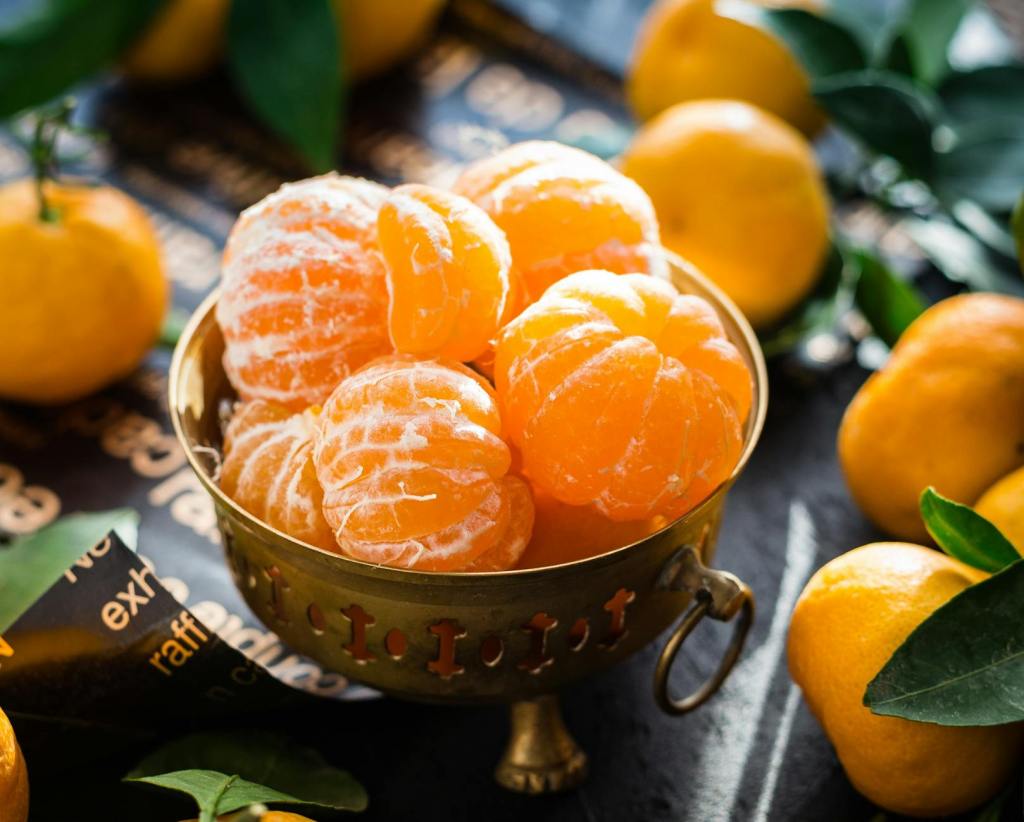
I suggest the clementine as a gateway. Eat your clementine outside. Feel the sun on your face and shoulders. Peel it slowly. Take in the citrus burst. Bite in. No seeds. Just sweet, juicy goodness.
I challenge you: eat a clementine in the sunshine after doing something a little physically hard—like running a race or walking with someone you love. Then tell me what, in that moment, could possibly be wrong in the world.
Clementines are a hybrid between a mandarin orange and a sweet orange, named after Father Clement Rodier who grew the fruits in an Algerian garden.2
But you don’t need to go to Algeria to get a clementine. Any number of grocery stores will gladly deliver a five-pound bag of clementines right to your door! What a time to be alive!
Science: Clementine Gets the Gold Star
I’ve been singing the praises of clementines for years (probably to the annoyance of whoever happens to be with me while I’m eating one). But a recent study validates my lived experience!
Scientists report that women who ate a medium-sized orange every day had a 22% lower chance of depression.4
This appears to be a real-deal, legitimate study — led by a scientist at Harvard Medical School who believes that eating oranges (and similar citrus, like clementines!) may increase levels of a beneficial gut bacteria that helps regulate mood.3
This particular study was specific to citrus. But once you begin connecting with the immediate sensory experience of real, nourishing food, you don’t need a study to tell you what makes you feel good.
Expand Your Circle of Joyful Food
Try the Clementine Challenge with other foods like seeds, nuts (what would Father Clement say about cashews, or, heaven help us, macadamias!), seafood and leafy greens.
Some of these foods take preparation. But the easiest preparation is also usually the most delicious. Look for recipes with a few, whole, staple ingredients. Use ChatGPT to help troubleshoot the execution. Once you get going, making real food can be easier than the processed alternatives.
It may help to look up the history of these whole foods, like I did with the clementine above. Many have romantic or ancient origins and have nourished people for centuries, long before Nabisco started deconstructing corn and re-constructing it into food simulacrum.
Processed Food Steals Joy
Processed foods don’t just steal nutrients—they steal joy. They wreak havoc on your mood, hijack your hunger and flatten your palate.
Parents know that sugary snacks can send kids bouncing off the walls, before the inevitable crash. Parents who want to have a good day today manage what their kids eat today.
But somehow, as adults, we think we’ve risen above this basic cause and effect. We haven’t.
The temptation is real: caffeine and sugar really do seem to make you think better, or at least faster! I spent too many years riding that roller-coaster and then wondering why I had a hair-trigger temper!
And, processed foods can make us forget what real food tastes like. Designed to be soft, predictable and uniform – we lose the joy of biting into a perfectly ripe cherry, or the crunch of a great slice of homemade bread.5
Five Small Changes with Big Impact
1) Replace sugar with honey. Still sucrose, but it affects the body differently – and tastes better.6 Made by bees, not machines, good honey is the opposite of factory-uniform. The taste changes based on which flowers the bees were pollinating: clover, wildflowers, orange blossoms. Extraordinary! [I love honey so much that I wrote a whole post about it here in my companion blog, Not Your Fiat Life.]
2) Pair sweet foods with protein and vegetables. Your body reacts better when sweetness is balanced.7
3) Upgrade your comfort food. My upgrade to boxed mac-and-cheese? Pasta, real butter, sharp cheddar, and some spinach or peas. Still indulgent—but satisfying, not flattening.
4) Get coffee right. Expensive coffees from the fancy coffee shop can have more sugar than a soda. My ritual is black coffee8 in the morning and espresso with homemade cashew milk in the afternoon. Half a cup of cashews, 2 cups water, and one loud blender. In five minutes you have delicious, rich, cashew milk that is no comparison to watered-down store-bought versions. Adding a drop of honey, maple syrup or vanilla extract turns it into a treat.
5) Use the Hedonic Treadmill to your advantage. Novelty and intelligent, temporary and limited deprivation can increase your joy. I’m personally happiest when I’m doing a 16:8 intermittent fast. Even carrot sticks taste so sweet when they break a morning fast!
Good Things Ricochet
Here’s the most beautiful part. Eating for mental health doesn’t just help you. It radiates outward.
Preparing simple, joyful food saves time, money, and energy. It makes you sharper, steadier, and more present in your work and relationships. It builds community—because nothing brings people together like good food.
You don’t have to be perfect. Everyone needs an Oreo now and then. But small changes, made with intention, can echo through your life in surprising and powerful ways. This is a rule of the universe: Good things ricochet.
Like this post? Subscribe here for more.
Footnotes
¹ Drew Ramsey, Eat to Beat Depression and Anxiety, Harper Wave, 2021, p. 52. ↩
² This story about the origin of the name of the clementine comes from Wikipedia. And if Wikipedia is “good enough” for Judge Posner, it is certainly good enough for me. United States v. Bazaldua, 506 F.3d 671 (7th Cir. 2007) (noting that Wikipedia is often “good enough” for general background). ↩
³ Can an orange a day keep depression away?” — interview with Dr. Raaj Mehta, Harvard Gazette, Feb 21, 2025. ~Read the interview. ↩
⁴ See, e.g., Mehta, R., et al. Citrus intake and its components are prospectively associated with a lower risk of depression and altered abundance of 15 gut microbial species. Microbiome, Nov 2024. ~View study on PubMed~ ↩
⁵ Even our teeth have changed! In Ultra-processed People, Chris Val Tullekin explains that many modern dental problems are caused by underdeveloped jaws from eating too much soft food. ↩
⁶ See, e.g., Shambaugh, P., Worthington, V., & Herbert, J. “Differential effects of honey, sucrose and fructose on blood sugar levels.” Journal of Manipulative and Physiological Therapeutics, 1991;14(2):91–95. ~View study on PubMed~ . ↩
⁷ See, e.g., American Diabetes Association, “How Does Food Impact Blood Glucose?” Diabetes Food Hub, https://diabetesfoodhub.org/blog/how-does-food-impact-blood-glucose.html
(“Fiber, fat, and protein help slow digestion and absorption of glucose from carbohydrate foods, so your blood glucose will rise more slowly after a meal.”); Joslin Diabetes Center, “Effects of Carbs, Protein and Fats on Glucose Levels,” https://joslin.org/news-stories/all-news-stories/education/2021/07/carbs-protein-fats
(“Fiber, protein and fats help to slow down the digestion of carbs and delay their absorption into the blood. This helps to prevent spikes in glucose levels after eating.”). ↩
⁸ I used to be a soda junky. Now I’m just as serious about my coffee. I hand grind my beans every morning and use an inverted Aeropress to make the smoothest cup of black coffee you’ve ever tasted. ↩


Leave a Reply